
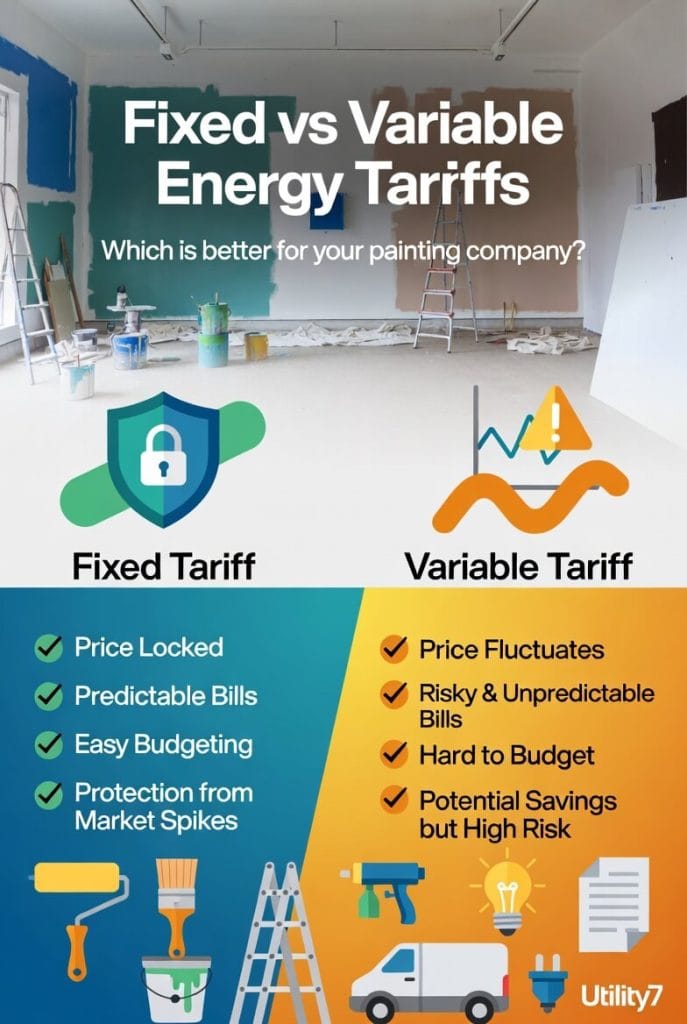
Fixed vs. Variable Energy Tariffs for Painting Companies: Which is Best?
For most painting businesses, a fixed-rate energy tariff is the smarter and more reliable choice — and here’s exactly why.
Running a painting company means managing multiple job sites, coordinating teams, sourcing materials, and keeping a firm grip on every operating cost. Energy bills might not be the most obvious overhead for a trade that works primarily on the road and on-site — but back at your base, workshop, or home office, choosing the wrong tariff can quietly erode your profit margins every single month. Understanding the difference between fixed and variable energy tariffs is one of the simplest ways to take control of what your painting business actually costs to run.
The Two Main Energy Tariff Types — Explained Simply
Fixed-Rate Tariff
With a fixed-rate tariff, the price you pay per unit of energy (kWh) is locked in for the duration of your contract — typically 12, 24, or 36 months. Your bill may still vary slightly depending on how much energy you use, but the unit rate itself won’t change regardless of what’s happening in the wider energy market. This means no surprises, no sudden spikes, and consistent pricing you can plan around.
Variable-Rate Tariff
A variable-rate tariff moves in line with the wholesale energy market. Prices can rise or fall — sometimes with very little notice. When energy prices drop, you could benefit from lower bills. But when prices spike, as they have done dramatically in recent years, your costs can increase significantly with very little warning.
Fixed vs. Variable Energy Tariffs for Painting Companies: Side-by-Side Comparison
| Feature | Fixed-Rate Tariff | Variable-Rate Tariff |
|---|---|---|
| Price Stability | Locked in for contract term | Changes with the market |
| Budget Planning | Easy — predictable monthly cost | Difficult — bills can vary widely |
| Market Savings | Not available | Possible when prices drop |
| Exit Fees | Usually applies | Often none |
| Best For | Stability-focused businesses | Risk-tolerant, active switchers |
Why Fixed-Rate Tariffs Suit Most Painting Companies
1. Predictable Costs = Better Budgeting
Painting businesses often experience seasonal peaks and quiet periods — busy summers and spring seasons, slower winter months, and the occasional gap between contracts. The last thing you need is an unpredictable energy bill adding yet another variable to your overheads. A fixed tariff lets you include a set energy cost in your monthly budget with complete confidence, making it far easier to manage cash flow across the full trading year.
2. Protection From Market Volatility
The wholesale energy market is notoriously volatile. Geopolitical events, seasonal demand, and supply disruptions can cause prices to spike rapidly. A fixed-rate contract insulates your business from these external shocks — meaning your bottom line stays protected even when the wider market turns against you.
3. Focus on Growing Your Business
Constantly monitoring energy prices and switching suppliers to chase lower variable rates takes time and headspace you simply don’t have when you’re managing jobs, quoting new work, and running a team. A fixed tariff removes that distraction entirely, freeing you to focus on what actually drives revenue — delivering quality work, winning repeat clients, and building your reputation.
4. Easier Financial Planning for Investment
Whether you’re planning to invest in a new spray system, purchase an additional van, upgrade your workshop equipment, or take on more staff, knowing your fixed overheads makes financial planning far more reliable. Lenders and accountants appreciate businesses that can demonstrate consistent and controlled operating costs when assessing applications.
When a Variable Tariff Might Still Be Worth Considering
Variable tariffs aren’t always the wrong choice. If wholesale energy prices are currently high and forecasted to drop significantly, locking into a fixed deal could mean overpaying relative to where the market moves. However, predicting energy markets is notoriously difficult — even professional analysts get it wrong regularly.
Variable tariffs can also make sense if your business is in transition — perhaps you’re planning to move your base of operations, scale down, or restructure in the near term and don’t want to be tied into a lengthy contract. Just make sure you’re actively monitoring prices and ready to act quickly if costs begin to rise.
Practical Steps to Choose the Right Tariff
- Review your last 3–6 months of energy bills to understand your typical usage patterns across busy and quiet periods.
- Identify your main energy draws — workshop equipment, spray booths, compressors, vehicle charging, lighting, and any heating in your storage or preparation space.
- Compare multiple suppliers — don’t assume your current provider is still offering the most competitive deal.
- Pay close attention to contract length, unit rates, standing charges, and any exit fees before committing.
- Ask about green energy options if sustainability matters to your brand — some commercial clients actively prefer contractors who can demonstrate environmentally responsible practices.
- Set a calendar reminder before your contract ends so you can reassess and switch before rolling onto a more expensive out-of-contract rate.
Key Energy Tips Specific to Painting Companies
Spray Equipment & Compressors: Air compressors and airless spray systems are among the most energy-intensive tools in a painter’s arsenal. Keeping equipment well-maintained, checking for air leaks regularly, and switching off compressors when not in active use can deliver meaningful reductions in energy consumption over time.
Workshop Heating: If you prepare surfaces, mix paints, or store materials in a workshop or garage, heating that space efficiently matters. A programmable thermostat and good insulation ensure you’re only paying to heat the space when it’s actually in use.
Vehicle Charging: If you’re transitioning to electric or hybrid vans, overnight vehicle charging will become a significant energy cost. Understanding your tariff’s off-peak rates and scheduling charging accordingly can make a real difference to your monthly bill.
Lighting: Workshop and yard lighting left on overnight adds up quickly. Installing motion-sensor lighting in storage areas and switching to LED throughout your base of operations is a low-cost upgrade with a fast payback period.
Office & Admin Equipment: Computers, printers, and routers used for quoting, invoicing, and scheduling left on standby overnight still consume power. Switching these off fully at the end of each working day is a simple habit that reduces your bill without any disruption to your workflow.
Final Thoughts
For most trade business owners, choosing between fixed vs. variable energy tariffs for painting companies comes down to one honest question: how much financial uncertainty can your business comfortably absorb? While variable tariffs can occasionally deliver short-term savings, the risk of sudden price rises makes them a less reliable foundation for a business where project-based income and seasonal fluctuations already require careful cost management.
The smartest move is to stay proactive — compare deals regularly, understand your usage patterns, and always switch before your contract rolls over to a default rate.
Ready to find a better energy deal for your painting company?
Visit Utility7 at www.utility7.com to compare energy tariffs tailored for small and independent trade businesses. It only takes a few minutes to find out if you could be saving — and in a business where margins are won and lost in the details, those savings matter more than you might think.