
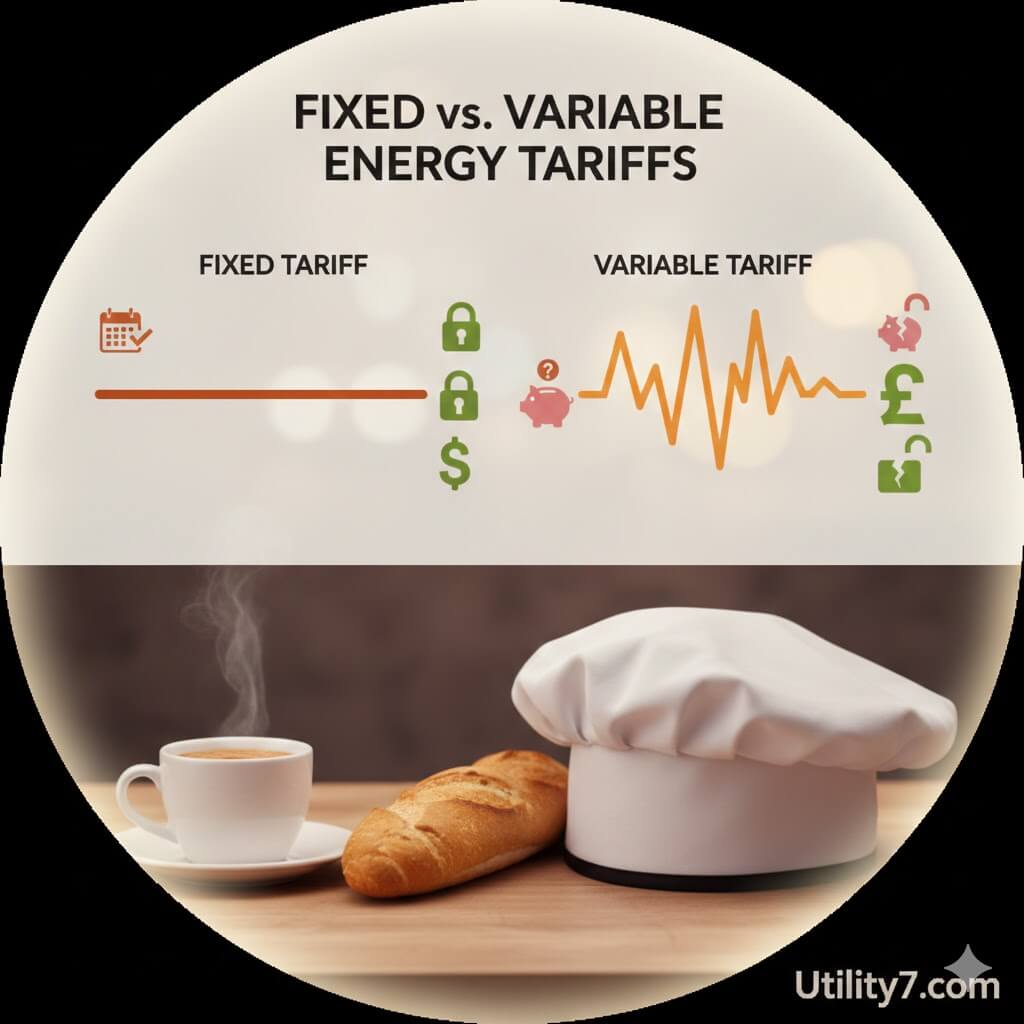
Fixed vs. Variable Energy Tariffs for Food Business Companies
For any food business – be it a bustling restaurant, a cozy café, a busy takeaway, or a large catering company – energy costs represent a significant portion of operational expenses. Making the right choice between fixed and variable energy tariffs isn’t just about saving a few pounds; it’s about securing financial stability and predictability in an often unpredictable market.
Understanding which tariff best suits your food business can lead to substantial savings and better budget management.
Deciphering Energy Tariffs: Fixed vs. Variable
Let’s break down the two primary types of business energy tariffs:
Fixed-Rate Tariff: This tariff locks in your energy unit price (pence per kWh) for the entire duration of your contract, which can range from 12 to 36 months. While your total bill will still vary based on your consumption, the cost per unit remains constant, offering price certainty.
Variable-Rate Tariff: With a variable tariff, the price you pay per unit of energy can change at any time, usually reflecting fluctuations in the wholesale energy market. This means your energy bills can go up or down, sometimes with short notice.
The Food Business Challenge: Continuous Energy Demand
Food businesses are unique in their energy demands. You rely heavily on electricity and gas for:
Cooking Equipment: Ovens, grills, fryers, hobs.
Refrigeration & Freezing: Essential for food safety and storage.
Heating & Cooling: Maintaining comfortable temperatures for staff and customers.
Lighting & Ventilation: Crucial for ambiance and hygiene.
This continuous, high-volume energy usage makes the tariff choice even more critical.
Why a Fixed-Rate Tariff is Often the Smarter Choice for Food Businesses
Given the consistent and often high energy consumption of food businesses, a fixed-rate tariff typically offers significant advantages:
Budget Predictability: Knowing your exact unit cost allows for precise budgeting. This is invaluable when planning menus, pricing dishes, and managing other fluctuating costs like ingredients and labor.
Protection Against Market Volatility: The energy market can be highly unpredictable. A fixed tariff shields your business from sudden spikes in wholesale energy prices, which could otherwise drastically increase your overheads and squeeze your profit margins.
Long-Term Financial Planning: With stable energy costs, you can make more confident long-term business decisions, whether it’s expanding your premises, investing in new kitchen equipment, or navigating seasonal demand changes.
Simplified Cost Management: Fixed rates simplify accounting and financial forecasting, allowing you to focus on culinary excellence and customer service rather than constantly monitoring energy market trends.
When to Approach Variable Tariffs with Caution
While variable tariffs offer the potential for lower bills if wholesale prices drop, they come with substantial risks for a food business:
Risk of Price Surges: A sudden increase in energy prices can quickly erode profits, especially for businesses operating on tight margins.
Budgeting Uncertainty: The unpredictability of variable rates makes accurate financial forecasting challenging, leading to potential cash flow issues.
Constant Monitoring Required: To potentially benefit from a variable tariff, you’d need to constantly monitor market prices, which is an additional, time-consuming task for busy food business owners.
Making the Right Energy Choice for Your Food Business
The consensus for most food businesses, especially those with consistent, high energy demands, is that a fixed-rate energy tariff provides the most robust financial security and predictability.
To ensure you secure the best deal:
Assess Your Usage: Understand your peak and off-peak energy consumption patterns.
Compare Business Energy Deals: Do not automatically renew with your current supplier. Use comparison services to find the most competitive fixed rates from various providers.
Review Contract Terms: Always check contract lengths, potential exit fees, and specific terms relevant to your business type.
By making an informed decision on your energy tariff, you can secure a stable foundation for your food business, allowing you to focus on what you do best: creating delicious experiences for your customers.
Ready to slash your food business energy bills? Don’t let fluctuating rates eat into your profits. [Contact Utility7 today] for a free comparison and find the perfect fixed-rate tariff tailored to your kitchen’s needs!